

Key Takeaways
- Understanding your 11kV system requirements is crucial for selecting the correct HT VCB Control Panel.
- Check the rated current against the connected load to ensure panel suitability.
- Evaluate network fault levels to confirm the VCB can handle expected short-circuit currents.
- Choosing the right protection scheme is vital for effective system performance and safety.
- Consider future expansion needs to avoid complications with your HT VCB Control Panel.
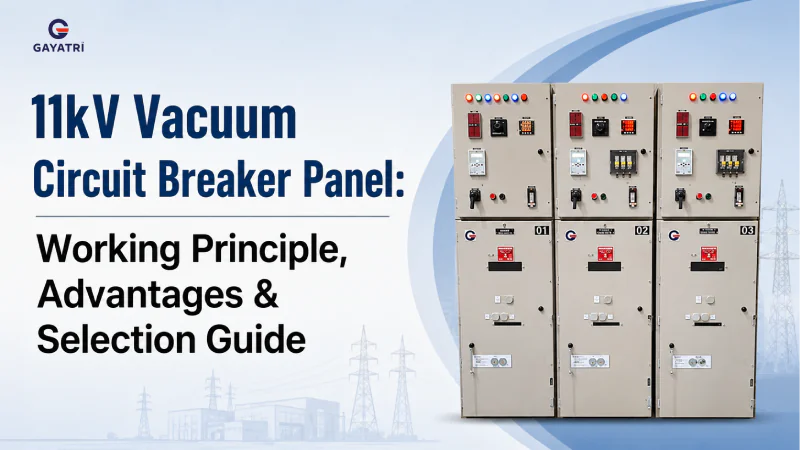
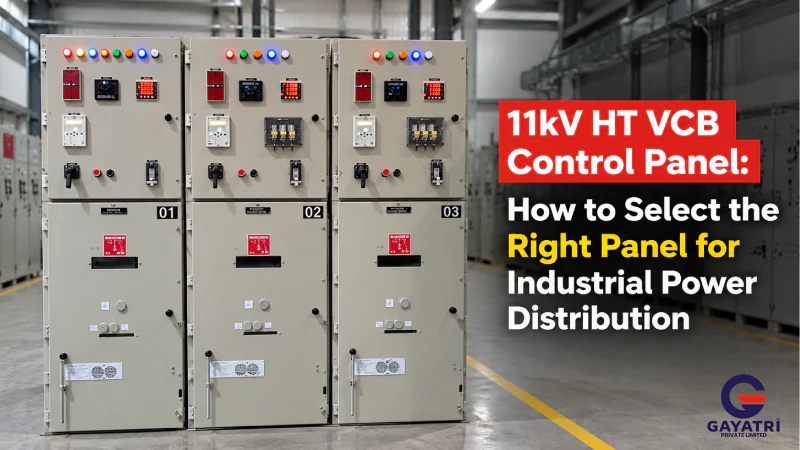
Gayatri Group, is a leading manufacturer of 11kV HT VCB Control Panels for industrial and infrastructure power distribution applications. Selecting an HT panel is not simply a matter of choosing an 11kV rating. The panel must match the network current, fault level, protection philosophy, switching duty, installation environment, and maintenance requirements.
As one of the HT VCB Control Panel Manufacturers, we believe buyers should evaluate the complete electrical duty before finalising a panel. A correctly selected VCB panel becomes part of the protection and switching backbone of the medium-voltage distribution system.
Start With the Actual 11kV System Requirement
The first step is to understand where the panel will operate in the electrical network. An incomer, transformer feeder, outgoing feeder, motor feeder, or distribution feeder may have different current and protection requirements.
Before panel selection, the project team should confirm:
- System operating voltage
- Required feeder current
- Busbar current requirement
- Available short-circuit level
- Number of incomers and outgoing feeders
- Protection and metering requirements
- Indoor or outdoor installation
This information helps prevent a situation where the panel fits physically but does not match the electrical duty.
Check Rated Current Against the Connected Load
Rated current should be selected from the expected continuous load and system design rather than by choosing the highest available value without justification.
Gayatri’s 11kV VCB panel information specifies feeder current up to 1250A and busbar current up to 2000A for the listed configuration.
The feeder rating and the busbar rating should be evaluated separately.Projects involving multiple outgoing feeders may need a bus arrangement designed to handle a higher current capacity than that required by each individual feeder.
Do Not Ignore the Network Fault Level
One of the most important technical checks is the prospective short-circuit current at the point where the panel will be installed.
A VCB must be capable of interrupting the fault current specified for the system. Gayatri’s listed 11kV panel data includes a rated short-circuit breaking current of 26.3kA and a short-time current withstand of 26.3kA for three seconds.
When comparing HT VCB Control Panel Manufacturers, buyers should therefore ask for the complete breaking, making, and short-time withstand ratings rather than comparing panels only by voltage and ampere rating.
Select the Protection Scheme Around the Application
The circuit breaker operates when commanded, but the protection system determines when that trip should occur. Relay selection should reflect the equipment and network being protected.
Typical requirements may include:
- Overcurrent protection
- Earth-fault protection
- Transformer-related protection
- Feeder protection
- Metering through suitable CTs and VTs
- Trip and alarm indications
Selecting a suitable protection scheme requires careful consideration of the electrical system’s specific needs. All protective components should work together as part of a coordinated system rather than treating each panel accessory separately.
Evaluate VCB Interlocking and Isolation Features
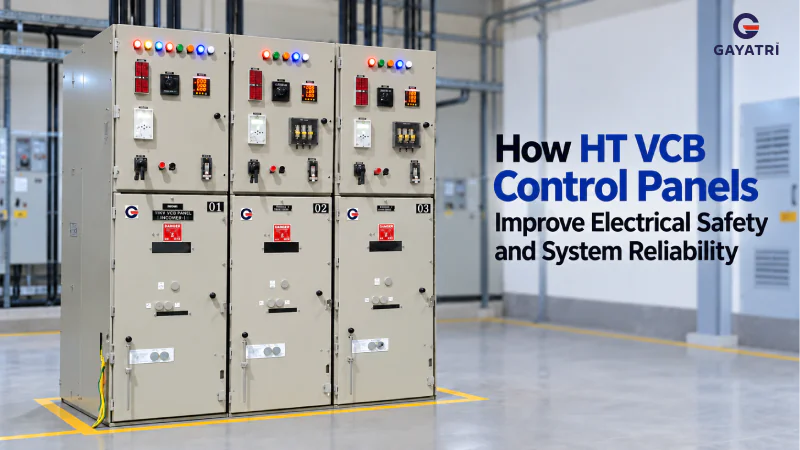
Medium-voltage switchgear must support controlled operation and maintenance. Mechanical and electrical interlocking systems enhance safety by restricting improper switching operations and preventing accidental access to live electrical components.
Gayatri’s 11kV panel information includes separate padlockable shutters for bus-side and cable-side fixed contacts, along with breaker-truck movement provisions associated with the cubicle design.
For maintenance teams, these design details can be as important as electrical ratings because they affect how isolation, inspection, and breaker handling are carried out.
Decide Between Indoor and Outdoor Panel Arrangements
Installation location changes what buyers should specify. Indoor switchgear may operate in a controlled electrical room, while outdoor panels are exposed to weather, dust, moisture, and wider environmental variations.
Gayatri Group offers medium and high-voltage products that include 11kV indoor VCB panel solutions as well as an 11kV outdoor VCB panel category. The outdoor panel listing includes 11/12kV ratings and current options of 630A, 800A, and 1250A.
The installation environment should therefore be discussed before enclosure design and equipment configuration are finalised.
Match the Panel to the Switching Duty
Not every VCB performs the same operational role. Some feeders may operate only occasionally, while others may experience more frequent switching.
Transformer protection, plant feeders, motors, capacitor-related applications, and utility distribution can place different demands on switchgear. The expected operating sequence and duty should be communicated clearly to HT VCB Control Panel Manufacturers during technical discussions.
This helps align the breaker mechanism, protection scheme, control circuit, and panel arrangement with actual site operation.
Check Withstand Ratings, Not Just Breaking Capacity
Breaking current receives considerable attention, but other dielectric and withstand parameters also matter in medium-voltage systems.
A proper technical comparison should include:
Parameter | What the Buyer Should Verify |
Rated voltage | Compatibility with the 11kV system |
Rated current | Feeder and busbar duty |
Breaking current | Maximum fault interruption requirement |
Short-time withstand | Thermal and dynamic fault duty |
Power-frequency withstand | Insulation capability |
Impulse withstand | Ability to tolerate specified transient voltage stress |
Reviewing these parameters together gives a more complete picture of panel suitability.
Check the Incomer and Outgoing Configuration
The number of feeders affects panel width, busbar arrangement, control wiring, metering, protection, and future expansion.
Gayatri’s completed-project records include 11kV HT VCB panels configured with one incomer and two outgoing feeders for project applications. Additional projects include 800A indoor HT panels and electrical distribution systems equipped with vacuum circuit breakers (VCBs).
This is why a buyer should provide a clear single-line diagram or feeder schedule rather than requesting a generic “11kV panel.”
Consider Future Expansion Before Finalising the Panel
Industrial units often tend to increase loads, transformers, feeders, or machinery at a later stage of operation. A panel designed based on today’s requirement alone may lead to further complications in the future.
Consider aspects like spare feeder capacity, busbar capacity, increased capacity of the protection system, provision for terminating cables, and possible extensions when designing the panel.
Hence, it is important for HT VCB Control Panel Manufacturers to know not only the existing load but also the proposed distribution system.
Use a Technical Checklist Before Placing the Order
Before releasing the panel for manufacturing, buyers should verify the main technical points against the approved electrical design.
- System voltage and frequency confirmed
- Feeder and busbar currents confirmed
- Fault level checked
- Required relay functions defined
- CT and VT requirements finalised
- Incomer and outgoing configuration approved
- Interlocking requirements reviewed
- Installation environment identified
- Cable entry and termination requirements defined
- Metering and control philosophy approved
A complete specification reduces ambiguity between the electrical consultant, buyer, panel manufacturer, and site team.
Why Choose Us
We, at Gayatri Group, produce medium and high voltage electrical panels meant for power distribution, including 11kV VCB panel solutions. The projects that we undertake involve supplying of HT VCB panels, 11kV indoor panels, incomer-outgoing systems and VCB systems in the industrial and infrastructure electrical systems. We are among the HT VCB Control Panel Manufacturers who consider aspects such as system ratings, feeders, protection, installation and configuration of the particular project before determining the right panel.
Conclusion
An 11kV HT VCB Control Panel Selection cannot be based solely on the voltage listed on the name plate. Rated current, bus bar rating, short circuit level, switching rating, protective relay, interlocks, feeder layout, installation site, and expandability must all be considered collectively.
At Gayatri Group, the process of selecting VCB control panels is done by focusing on the electrical system rather than assuming all 11kV applications are similar. By consulting professional HT VCB Control Panel Manufacturers, industrial customers have the chance to list out their technical requirements prior to manufacturing.
Planning an 11kV power-distribution system or replacing an existing HT panel? Gayatri Group can discuss your feeder arrangement, fault-level requirements, protection scheme, current ratings, and VCB panel configuration before you place the order.
Call +91 9375065185 or email marketing@gayatrigroup.org today to discuss your 11kV HT VCB Control Panel requirement and request a quotation.
Frequently Asked Questions
What should I consider when selecting an HT VCB Control Panel?
When selecting an HT VCB Control Panel, consider the system operating voltage, required feeder current, busbar current, available short-circuit level, and the number of incomers and outgoing feeders. It’s essential to evaluate the complete electrical duty to ensure the panel meets the specific needs of your power distribution system.
How do HT VCB Control Panel Manufacturers determine the right panel for my application?
HT VCB Control Panel Manufacturers assess your specific requirements, including network configurations and operational needs. They consider factors like switching duty, protection schemes, and environmental conditions to provide a panel that aligns with your electrical system’s actual demands.
What is the importance of understanding the network fault level in selecting a VCB?
Understanding the network fault level is critical because the VCB must be capable of interrupting the specified fault current. This ensures the safety and reliability of the electrical system, as an appropriately rated VCB can prevent equipment damage during fault conditions.
What are the benefits of having interlocking and isolation features in an HT VCB Control Panel?
Interlocking and isolation features enhance safety by restricting improper switching operations and preventing accidental access to live electrical components. These mechanisms are crucial for maintenance teams and help ensure safe handling and operation of the panel.
How can I prepare for future expansion when choosing an HT VCB Control Panel?
To prepare for future expansion, consider aspects like spare feeder capacity, busbar capacity, and the potential for additional transformers or machinery. Sharing your projected growth plans with HT VCB Control Panel Manufacturers will help them design a panel that accommodates future demands.