
Key Takeaways
- ACDB and DCDB panels are crucial for reliable protection and efficient power distribution in solar energy systems.
- Proper ACDB and DCDB panels enhance system reliability and simplify maintenance in diverse solar projects.
- Gayatri Private Limited manufactures ACDB and DCDB panels designed to withstand India's extreme weather conditions.
- Investing in high-quality ACDB and DCDB panels can protect your solar system from electrical faults and surges.
- For maximum safety and performance, choose an experienced ACDB and DCDB panel manufacturer in India like Gayatri Private Limited.
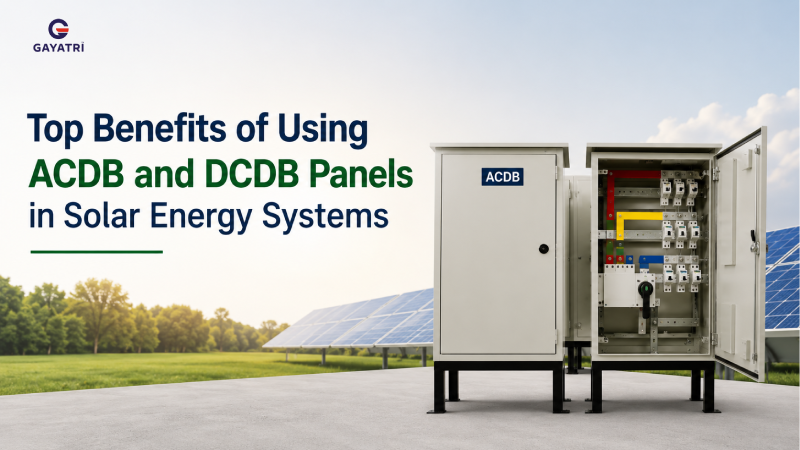
The rapid growth of solar energy has transformed the way industries, businesses, and homeowners generate electricity. As solar power installations continue to expand, the importance of reliable electrical protection and distribution systems has become more significant than ever. Among the most critical components in any solar power plant are ACDB (AC Distribution Box) and DCDB (DC Distribution Box) panels. These panels play a vital role in protecting solar systems, distributing power efficiently, and supporting long-term operational performance.
Whether it is a rooftop solar project, commercial solar installation, industrial solar plant, or utility-scale solar farm, ACDB and DCDB panels are essential for managing electrical flow safely. They help protect equipment from electrical faults, improve system reliability, and simplify maintenance activities.
What Exactly Are ACDB and DCDB Panels?
Let’s start with the basics, because a lot of project stakeholders — even experienced ones — sometimes blur the distinction between these two components.
The DCDB (DC Distribution Box) sits between your solar PV array and the inverter. Every string of solar panels feeds into it. Inside, you have string fuses or MCCBs that prevent reverse currents from damaging modules, surge protection devices that handle lightning transients, and DC disconnect switches for safe isolation. Think of the DCDB as the gatekeeper on the solar side of your plant — nothing gets through to the inverter without passing its protection.
The ACDB (AC Distribution Box) takes over on the other side of the inverter. It receives the AC output and distributes it toward the grid connection or local load. It houses AC MCCBs, surge protection devices, isolation switches, and in many configurations, energy meters and protection relays. The ACDB is your last line of defense before power leaves the inverter and enters either the building’s distribution system or the utility grid.
Together, the ACDB and DCDB Panel cover both ends of the solar energy chain. One protects what comes in from the sun. The other protects what goes out to the grid. Neither can be skipped, and neither should be underspecified.
The Real Benefits — What Good ACDB and DCDB Panels Actually Deliver
Protection That Works When It Matters Most
The most straightforward benefit is also the most important one: protection. Solar plants deal with high DC voltages (often 600V to 1000V on the string side), significant AC fault currents, and the constant threat of lightning-induced surges. A fault that isn’t cleared within milliseconds can cascade into inverter destruction, cable fires, or damaged modules.
Gayatri Private Limited’s ACDB and DCDB Panel is rated for up to 630A maximum current, with a system voltage of 440V AC and a rated insulation voltage of 690V AC. These are not arbitrary numbers — they reflect real operating margins that keep the panel performing safely even under abnormal conditions. The string fuses on the DC side clamp fault currents before they travel back into the PV array. The MCCBs on the AC side respond to overloads and short circuits faster than any manual intervention ever could.
Built to Handle India’s Weather — All of It
Here is something that does not get enough attention in panel specifications: ambient temperature rating. Most of India’s best solar sites are also its hottest. Rajasthan, Gujarat, Andhra Pradesh — these are places where summer temperatures regularly touch 45°C or climb above it. Standard electrical panels derive significantly at these temperatures, meaning the components inside them cannot actually deliver their rated performance when the plant needs it most.
Gayatri Private Limited designs its panels for an ambient temperature of up to 50°C. Every component inside — the MCCBs, SPDs, busbars, terminal blocks, wiring — is selected with this operating reality in mind. The panels do not quietly derate on a hot June afternoon. They perform as rated, which is exactly what you need during peak generation hours.
And then there is the rain. India’s monsoons are not gentle. Coastal installations deal with salt-laden humidity year-round. Ground-mounted plants in open fields get hit by dust storms, heavy rain, and sometimes both in the same afternoon. Gayatri Private Limited’s panels carry IP54 to IP65 protection ratings. IP65 is fully dust-tight and handles direct water jets — the standard for outdoor solar installations anywhere in India. IP54 works well for semi-protected outdoor locations and industrial indoor environments. You pick what the site demands.
Surge Protection That Stands Between Your Inverter and a Lightning Strike
Inverters are expensive. A central inverter for a multi-MW solar plant can cost several lakhs of rupees. A single lightning strike — even one that hits the ground several hundred meters away — can induce a surge large enough to destroy one through an unprotected DC string circuit.
Every ACDB and DCDB Panel from Gayatri Private Limited incorporates surge protection devices on both the DC and AC sides. These SPDs respond in nanoseconds, clamping the surge voltage before it reaches sensitive electronics. It is one of those protections you hope you never need — but you will be extremely grateful for it the one time you do. For plants in regions with high lightning incidence, this feature alone justifies the investment in a properly specified panel.
Safe Isolation for Maintenance — A Practical Necessity
A 25-year plant life means a lot of maintenance cycles. Modules need cleaning. Inverters occasionally need servicing. Cables get inspected. Every one of these tasks requires someone to work in proximity to live electrical circuits, and the ability to safely isolate specific sections without shutting the whole plant down is not just convenient — it is a legal and safety requirement.
The panels from Gayatri Private Limited include lockable disconnects and isolation switches that allow individual strings (DC side) or individual AC circuits to be taken out of service independently. A maintenance technician can isolate a single string for inspection while the rest of the array continues generating. This kind of practical, thoughtful design is what separates a panel built by an experienced manufacturer from one that merely meets minimum specifications on paper.
Versatility Across Every Solar Project Type
Not every solar project looks the same. A 10 kW rooftop system on a commercial building in Ahmedabad has very different installation requirements than a 50 MW ground-mounted plant in the Thar Desert. The ACDB and DCDB Panel range from Gayatri Private Limited covers both ends of this spectrum — and everything in between.
For rooftop systems, compact indoor-rated panels (IP54) fit neatly into electrical rooms without taking up unnecessary space. For ground-mounted utility plants, outdoor IP65-rated panels are mounted directly at combiner locations within the array field, often in areas with no shade, direct rainfall, and significant dust exposure. The same manufacturer, the same quality standards, the same rated performance — across both form factors. That consistency matters enormously for EPC contractors managing multiple project types simultaneously.
Standards Compliance That Keeps Your Project on Schedule
Grid-connected solar projects in India go through multiple levels of regulatory approval — CEA regulations, DISCOM requirements, and various IEC standards for photovoltaic systems all come into play. An ACDB or DCDB panel that does not meet these requirements can hold up the commissioning and grid approval process for weeks, creating delays that have real financial consequences.
Gayatri Private Limited manufactures its ACDB and DCDB Panel range to meet applicable IEC and national standards. When your project’s commissioning engineer presents documentation to the utility or regulator, the panels are already where they need to be from a compliance standpoint. No last-minute substitutions, no scrambling for alternative documentation. The paperwork matches the hardware.
Where These Panels Are Used
Rooftop Solar (Commercial & Industrial): Both the ACDB and DCDB fit cleanly into the electrical rooms of factories, warehouses, hospitals, and commercial complexes. The IP54 indoor variant handles these environments well.
Ground-Mounted Utility Solar Farms: Large-scale plants use outdoor IP65-rated DCDBs at each combiner point within the array field and ACDBs at inverter skid level. Gayatri Private Limited has supplied panels for exactly these kinds of projects across India.
Solar Pumping Projects: Agricultural solar pumps — a fast-growing segment in India — use DCDB panels to protect the array feeding the pump controller and ACDB panels on the output side. Government irrigation schemes and private farms both rely on this configuration.
Industrial Captive Plants: Factories installing solar for self-consumption integrate ACDB and DCDB panels into their existing LT electrical distribution scheme, often alongside other Gayatri Private Limited panel products like PCC panels and ATS panels.
Why Choose us
Over 40 years in the electrical panel manufacturing business gives you a particular kind of perspective — one that comes only from having seen what works in the field and what does not. Gayatri Private Limited has completed more than 5,000 projects across government and private sectors, supplying panels to organizations like ISRO, NHPC, IOCL, Indian Railways, and Municipal Corporations. The company’s panels are not designed in isolation from real-world conditions. They are built with an understanding of India’s heat, its monsoons, its grid requirements, and its maintenance realities. With a product range exceeding 100 panel types and a team that can customize solutions for specific project requirements, Gayatri Private Limited has earned its position as a trusted ACDB and DCDB Panel Manufacturer in India for solar EPC contractors, developers, and consultants who cannot afford to compromise on protection quality.
Conclusion
When you invest in a solar power plant, you are investing for 25 years. The ACDB and DCDB panels you choose will be out there on that site for every one of those years — through summer heat, monsoon rain, lightning seasons, and thousands of maintenance cycles. Choosing panels that are properly rated, well-constructed, and backed up by a manufacturer with genuine field experience is not a premium option. It is the only sensible option. Gayatri Private Limited delivers exactly that — purpose-built, standards-compliant panels that protect your solar investment from day one through the life of the project.
Protect your solar investment with the right panels from the start. Reach out to Gayatri Private Limited — a leading ACDB and DCDB Panel Manufacturer in India — for custom specifications, technical support, and project-specific quotes.
Call us: +91 9375065185 Email us: marketing@gayatrigroup.org
Frequently Asked Questions
What is the role of ACDB and DCDB panels in solar energy systems?
ACDB (AC Distribution Box) and DCDB (DC Distribution Box) panels are crucial for the protection and distribution of electricity in solar power systems. The DCDB connects the solar PV array to the inverter, safeguarding against reverse currents and surges, while the ACDB distributes the output from the inverter to the grid or local loads.
How do ACDB and DCDB panels protect solar systems?
These panels protect solar systems by preventing electrical faults such as overloads and short circuits. They include surge protection devices that clamp down on harmful surges and isolation switches that allow maintenance personnel to work safely on specific circuits without shutting down the entire system.
Why should I choose Gayatri Private Limited as my ACDB and DCDB Panel Manufacturer in India?
With over 40 years of experience, Gayatri Private Limited has a proven track record of delivering high-quality, standards-compliant ACDB and DCDB panels. The company understands the unique requirements of India’s climate and regulatory landscape, ensuring that their products perform reliably in demanding conditions.
What kind of projects can benefit from ACDB and DCDB panels?
ACDB and DCDB panels are versatile and can benefit a wide range of solar projects, including rooftop systems for commercial buildings, ground-mounted utility solar farms, and even solar pumping projects. Their design and specifications cater to different installation requirements, making them suitable for various applications.
What are the advantages of using IP54 and IP65 rated ACDB and DCDB panels?
IP54 and IP65 ratings ensure that the panels are protected against dust and water ingress, making them suitable for outdoor installations. IP65-rated panels are fully dust-tight and can endure direct water jets, which is essential for maintaining performance in India’s diverse weather conditions, including heavy rain and dust storms.