

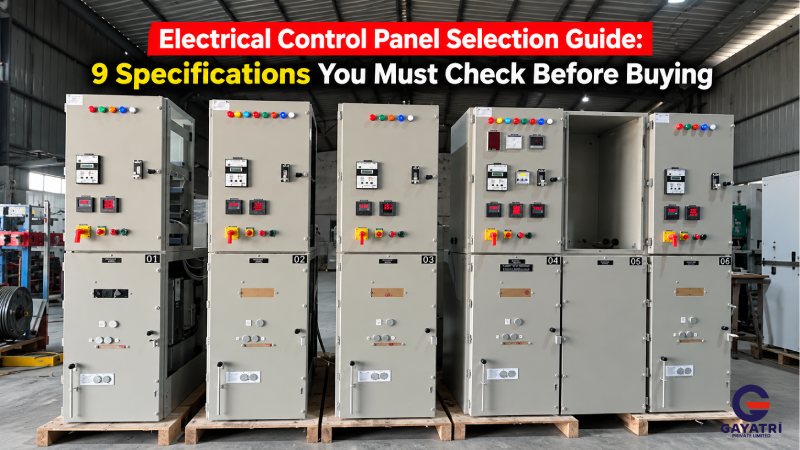
Key Takeaways
- Identify the panel's application to ensure it meets specific electrical needs before requesting a quotation.
- Check system voltage and frequency to match your electrical network specifications for optimal performance.
- Specify the rated current based on actual demand to accommodate future expansion and operational diversity.
- Verify short-circuit and protection requirements to prevent potential safety hazards during installation.
- Select the appropriate degree of protection for environmental conditions to ensure panel durability.
Gayatri Group, is a leading manufacturer of Electrical Control Panels. Buying an industrial electrical panel should never begin with enclosure size, appearance, or a basic ampere rating alone. The real question is whether the panel matches your incoming supply, connected load, protection philosophy, installation environment, and future operating requirements.
As an Electrical Control Panel Manufacturer in India, we regularly see how small specification gaps at the purchase stage can create difficult installation, protection, maintenance, or expansion issues later. Before approving a control panel, these nine technical points deserve close attention.
1. Define the Panel’s Actual Application First
A panel designed for main power distribution has a different role from one intended for motor control, power-factor correction, automation, metering, or changeover operations.
Before requesting a quotation, clearly identify whether the requirement is for a PCC, MCC, APFC, VFD/automation panel, DG synchronising panel, metering panel, feeder panel, or another distribution application.
The panel type should follow the electrical duty—not the other way around.
A serious discussion with Electrical Control Panel Dealers in India should therefore begin with your load schedule, application and operating sequence rather than only the physical panel dimensions.
2. Check the System Voltage and Frequency
System voltage is one of the first specifications that must match the electrical network. For example, Gayatri’s MCC range is specified for a 440 V AC system with a rated insulation voltage of 690 V AC.
The buyer should provide:
- Nominal operating voltage
- Number of phases
- System frequency
- Incoming supply arrangement
- Control voltage requirements
These values influence component selection, insulation requirements, metering, control circuits and protection architecture.
3. Specify the Correct Rated Current
The current rating of a panel should be determined by considering more than just the load currently connected to it. Engineers should consider actual demand, operating diversity, feeder requirements and reasonable future expansion.
Gayatri’s MCC panels, for example, are listed with maximum rated current capability up to 6300A, depending on configuration.
When approaching an Electrical Control Panel Manufacturer in Ahmedabad, provide the individual feeder ratings and expected maximum demand rather than simply stating that you need a “high-capacity panel.”
4. Verify Short-Circuit and Protection Requirements
Normal operating current tells only part of the electrical story. The panel and its protective components should also be evaluated to ensure they can safely withstand potential fault conditions at the installation site.
Your project engineer should establish the relevant fault level and protection requirements before finalising equipment.
Critical information can include:
- Available short-circuit level at the panel
- Upstream protection arrangement
- Required breaker ratings
- Feeder protection requirements
- Coordination requirements
- Earthing arrangement
Fault-duty requirements should be confirmed during engineering—not discovered during commissioning.
5. Select the Right Degree of Protection
An electrical panel installed in a clean indoor electrical room faces different environmental conditions from one exposed to dust, moisture, industrial contaminants, or outdoor conditions.
Gayatri’s MCC range lists IP54 as its degree of protection. However, buyers should select enclosure protection according to the actual site rather than automatically requesting the same IP rating for every application.
A capable Electrical Control Panel Manufacturer in India should therefore ask where the panel will be installed and what environmental conditions it will face.
6. Review the Busbar and Distribution Arrangement
Busbar systems transport the energy from the incomer to outgoing feeders, thus making the structure of busbars a key element in the panel design.
It is advisable for the purchaser to consider rated current, bus system, phasing, need for the neutral conductor, earthing, and distribution.
In cases where there are several outgoing feeders, it is essential that the internal structure is suitable for easy identification, cable routing, and maintenance.
7. Check Incomer and Outgoing Feeder Configuration
Do not approve a control panel based on only its total current rating. Review how power actually enters and leaves the panel.
A useful feeder schedule normally identifies each circuit by:
Check Point | What the Buyer Should Confirm |
Incomer | Source, rating and switching requirement |
Outgoing feeders | Quantity and individual load rating |
Motor feeders | Motor duty and starting method |
Spare feeders | Present and future requirement |
Metering | Parameters that need monitoring |
Control | Local, remote or automated operation |
This information gives Electrical Control Panel Dealers in India a much clearer basis for preparing the correct configuration.
8. Plan for Future Expansion Before Manufacturing
The electrical load on the industries is not going to remain static all the time. Further installation of motors, process equipment, pumps, utilities, automation or production machinery may give rise to the new electrical demand.
We like these needs to be discussed while designing the panels since further expansion after commissioning of the panel is not always an easy task.
As an Electrical Control Panel Manufacturer in Ahmedabad, it would be better if these considerations come up before manufacturing the control panels.
9. Review Testing, Documentation and Project Scope
Do not limit yourself to electrical hardware only for the final specification. The buyers need to make clear whether there is any document requirement, inspection, testing, installation, or commissioning involved in the project scope.
At Gayatri Group, apart from the turnkey projects, our additional electrical services include panel manufacture, substations, downstream electrical services, and EPCs. The portfolio of completed projects also mentions the scope of supply, installation, testing, and commissioning for electrical panels/switchgears.
Check the drawings, feeder schedule, identification of panels, testing scope, and responsibilities between panel manufacturers, electrical contractors, and site crew before making the order.
Why Choose Us
In Gayatri Group, our expertise in manufacturing electrical panels is combined with the knowledge of electrical contracting and turnkey infrastructure projects. Manufacturing operations in electrical products started in Gujarat in 2010, after electrical contracting operations that had been conducted since 1983. Our current product portfolio includes Low Tension Panels, Medium Voltage Panels, and Control & Relay Panels. We are an Electrical Control Panel Manufacturer in India who looks at panel requirements based on the application of the electrical requirement.
Conclusion
Choosing an electrical control panel is an engineering exercise, rather than just a purchasing task. Considerations like application, voltage rating, current rating, fault specifications, protection of the enclosures, busbar arrangements, feeders and other expansion possibilities and documentations need to be considered before confirming the order. Gayatri Group deals with industrial and commercial electrical applications, where all such factors determine the practicality of the installation and operation of the control panel.
While considering an Electrical Control Panel Manufacturer in Ahmedabad or Electrical Control Panel Dealers in India, it would be better if the supplier has the capability to understand the entire electrical requirement, and not just the name of the panel and the ampere rating.
Planning a new LT, HT, motor-control, distribution or customised electrical control panel for your facility?
Contact Gayatri Group to discuss your load requirements, feeder configuration and project specifications with our team.
Call +91 9375065185 or email marketing@gayatrigroup.org today to discuss your electrical control panel requirement and request a quotation.
Frequently Asked Questions
What should I consider first when selecting an electrical control panel?
The most important consideration is the panel’s actual application. You need to clearly define whether you require a PCC, MCC, APFC, VFD panel, or another type before moving forward with a purchase.
How do I verify the current rating needed for my electrical control panel?
To specify the correct current rating, consider your actual demand, operating diversity, and any reasonable future expansion needs. It’s crucial to provide the individual feeder ratings and expected maximum demand to the manufacturer.
What are the different types of electrical control panels available?
Common types include Power Control Centers (PCC), Motor Control Centers (MCC), Automatic Power Factor Correction (APFC) panels, and Variable Frequency Drive (VFD) panels. The type you need depends on your specific application requirements.
Why is environmental protection rating important for electrical control panels?
The degree of protection is vital as it ensures that the panel can withstand environmental conditions like dust, moisture, or industrial contaminants. It’s essential to choose an appropriate IP rating based on the installation site.
How can I find reliable Electrical Control Panel Dealers in India?
To find trustworthy dealers, consider their experience, the range of products they offer, and their ability to understand your specific electrical requirements. It’s beneficial to consult with manufacturers like Gayatri Group who have a comprehensive understanding of the market.