
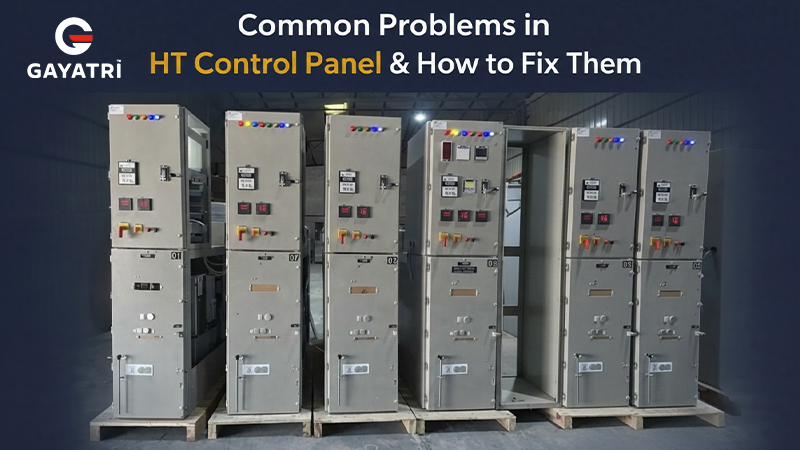
HT Control Panels are currently essential in the distribution and control of high-voltage electrical power in industrial and commercial electrical systems to provide safe and reliable distribution and control. Gayatri Private Limited is a major HT Control Panel Manufacturer in India; therefore, with years of experience, the Company has been able to design, manufacture, and service HT panels that could withstand heavy-duty application, high criteria and diverse environmental parameters. Discusses the most frequent issues encountered by the HT control panels in the field, real-life applications to halt them and important remarks to minimize down time and lengthen the life of your control property. We are still very much focused on you and your requirements of clarity, reliability, and solutions to take.
What Is an HT Control Panel and Why It Matters
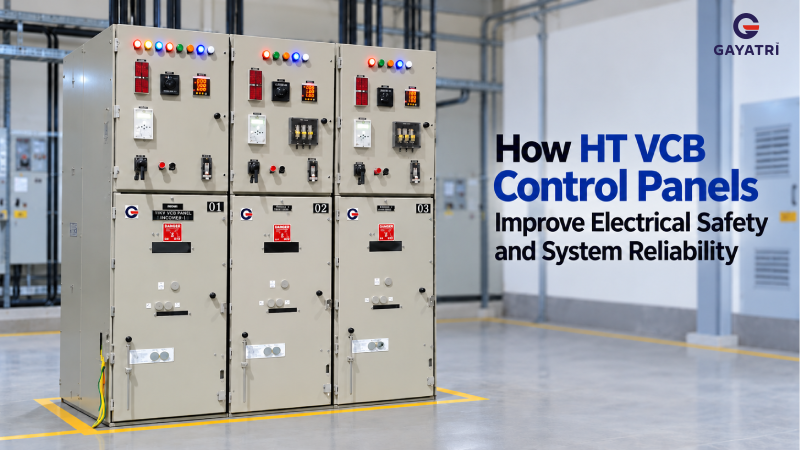
The control panel is designed with higher voltages, generally more than 1 kV, and is called an HT (High Tension) control panel. They form the basis of factory-based, commercial complex, utility, and important installation electrical infrastructure. HT panels combine circuit breakers, protection relays, metering, busbar, isolators and safety interlocks to make certain the equipment with high load is stable and the distribution of power is smooth. Making the correct choice based on the HT Control Panel Manufacturer; that is, a reliable choice of a manufacturer such as Gayatri Private Limited can greatly help to minimize operational problems and improve the performance of the system.
Common Problems in HT Control Panels and How to Fix Them
Overheating of Components
Problem: One of the most common problems with the HT control panels is overheating. The overheating may cause deterioration of the insulation, damage to sensitive parts of the panel such as VCBs (Vacuum Circuit Breakers) and may also shorten the life of the panel.
Causes & Fixes:
- Poor ventilation: The heat is trapped due to poor ventilation. Enhance ventilation or put in place cooling fans and heat exchange.
- Load imbalance: The load is not distributed equally and as a result, one phase may be overworked. Equalize the load and test the settings.
- Loose connections: The loose terminals and joints have heat, which is produced by resistance. Check all connections on a regular basis.
Frequent Tripping of Breakers
Problem: HT panel Tripping These are circuit breakers or protective devices that are installed into the panel, which frequently interrupts power.
Causes & Fixes:
- Overload conditions: Identify and decrease loads above a breaker rating.
- Faulty equipment: Diagnostic devices should be used to identify and fix broken downstream equipment.
- Incorrect settings: Check that protective relays settings are correct to system specification.
Loose or Faulty Wiring
Problem: Connection Vibrations and Thermal cycling can eventually cause connections to become loose and create an arcing effect or voltage drop or malfunction.
Causes & Fixes:
- Poor installation: Proper torque tools should be used, and wiring standards should be considered.
- Wear and tear: Check and repair worn out wires and connections.
- Improper routing: Cable management should be well maintained in order to prevent stress points.
Moisture and Corrosion
Problem: Moisture intrusion causes the likelihood of short circuiting, insulation failures and faster corrosion of metal components.
Causes & Fixes:
- Environmental exposure: panels should be used with proper IP ratings when they are used in the outdoor or wet environment.
- Seal gaps: Clean protective seals and make sure that doors are closed.
- Use dehumidifiers: In humid climates, internal heating or controlling measures are to be considered.
Insulation Failures
Problem: Electricity tracking, short circuiting, and unexpected failures may be caused by the degradation of insulation.
Causes & Fixes:
- Aging materials: up-date panel components at end-of-life.
- Moisture: make sure there is no moisture and periodically check the IR (Insulation Resistance).
- Overvoltage: Surge arrestors should be used in protecting systems against voltage surges.
Faulty Protection Relays
Problem: Problems with protection relays are intended to fault them off. They may not only fail to safeguard your system in case they malfunction, but also over-trip.
Causes & Fixes:
- Incorrect settings: Take the relays according to the requirements and used by manufacturers.
- Component failure: Relays or other components that are subjected to aging or errors should be periodically tested and replaced.
Power Supply Instability
Problem: The panel functions will be upset by voltage sagging, surging, or unstable input power and malfunction of sensitive equipment.
Causes & Fixes:
- Utility instability: Use power conditioning devices or UPS systems where necessary.
- Internal issues: Check the grounding and bonding to prevent floating potential.
Human Error and Operational Mistakes
Problem: The misuse of improper alternating, bypassing interlocks, and untrained staff is likely to cause severe accidents or expensive downtimes.
Causes & Fixes:
- Lack of training: See that all the operators are trained and conversant with the safety procedures.
- Poor labeling: Laboratory all parts and terminals must be properly labeled.
- Documentation: Keep proper wiring scheme and operation manuals.
Why Choose Us
In Gayatri Private limited, we have established our brand as a reliable manufacturer of HT Control panel in India through emphasis on quality, precision engineering, and client oriented solutions. Our HT control panels have decades of experience and understanding of the requirements of industrial power and can be used to work in the most challenging electrical conditions without sacrificing the safety level. Our values lie in reliability, durability and performance in all solutions that we develop, supported by attentive after-sales support and useful guidance. By collaborating with Gayatri Private Limited, you enjoy the advantage of creative design solutions and quality and the promise of aiding your systems to operate efficiently daily.
Conclusion
Common issues in the HT control panels can be understood and dealt with to ensure that power continuously flows and that there is efficiency in the control panel. Since it may be overheating and loose connections, insulation breakdown, and unstable power supply, all these problems could be dealt with right with the appropriate approach and frequent attention to them. When the right HT Control Panel Manufacturer is chosen like Gayatri Private Limited, it will mean that you get a well-engineered panel that is optimized to work well, with a lot of troubleshooting costs, and with long reliability. Periodic checkups, maintenance, advanced diagnostic equipment and experienced employees are your friends to avoid expensive downtime and improve safety of your entire electrical system. When using the fixes and preventative measures outlined herein, you will not only increase the life expectancy but also provide a safer and more productive working environment with regard to your operations.
For more insightful on HT panels, call us at +91 9375065185 or email marketing@gayatrigroup.org.
Key Takeaways
- HT panels fail slowly. Then suddenly: Heat, loose joints, moisture. Small things ignored. Work ceases until one day the panel falls.
- Tripping constantly is not a vice: Overloads. Wrong relay settings. Maladaptive downstream equipment. The panel is reacting. Doing its job.
- The environment is even more important than one may believe: Humidity, dust, poor sealing. They creep upon the insulation and metal components. Damage adds up.
- Maintenance is not expensive as compared to shutdowns. Always: Thermal scans. Tightening checks. IR testing. Simple routines. Big relief later.
- Good design requires good functioning: The finest HT control panel presents difficulties with untrained hands. Right panel. Right people. Smooth running.
FAQs
What is the most frequent problem that leads to the tripping of HT panels?
Tripping frequently is a result of overloading, intermittent power supply or erroneous protective settings and this need system analysis to rectify.
What can be done to minimize overheating in HT control panels?
Ensure the ventilation, loads, and connections are improved frequently to avoid accumulation of heat.
Why is moisture bad for HT panels?
Dampness causes corrosion, short circuits and insulation breakdowns therefore ensures that panels are properly enclosed and dried.
What are the frequencies of inspection of the HT panels?
The visual check-ups can be routinely done once every week and detailed check-ups once every month or year depending on the intensity of use.
Will human error impact on the performance of HT panels?
Yes–lack of proper functioning or improper labeling may lead to failure, this is the reason why we need proper training and records.