


Key Takeaways
- Selecting the right power distribution method is critical for operational efficiency and safety in any facility.
- Radial distribution systems offer simplicity and cost-effectiveness for smaller commercial buildings.
- Ring main systems provide enhanced reliability by allowing power to be rerouted during faults.
- Interconnected distribution systems are ideal for facilities requiring uninterrupted power, like data centers and hospitals.
- The Best Power Distribution Board Manufacturers in India ensure panels are engineered for real-world conditions, enhancing reliability.
Modern industries, commercial buildings, institutions, and infrastructure projects depend on uninterrupted electrical power to maintain productivity and safety. While power generation receives significant attention, the distribution of electricity plays an equally important role in delivering reliable performance. A properly designed power distribution system minimizes energy loss, improves operational efficiency, enhances safety, and supports long-term equipment performance.
Power distribution methods have evolved significantly to meet the growing demands of industrial automation, commercial facilities, healthcare institutions, manufacturing plants, and residential complexes. Selecting the right distribution method involves understanding electrical loads, safety requirements, future expansion plans, maintenance needs, and environmental conditions.
Businesses searching for Power Distribution Board Manufacturers in India often prioritize product quality, compliance with electrical standards, durability, and technical support. Similarly, organizations looking for the Best Power Distribution Board Manufacturers in India seek reliable partners capable of delivering customized solutions for diverse applications.
Why Power Distribution Method Selection Matters
Before diving into methods, it helps to understand what is actually at stake. Power distribution is not just about running cables from a source to a load. It involves managing current capacity, voltage stability, fault protection, environmental exposure, and future scalability, all at once. A poorly planned distribution system can lead to voltage drops, nuisance tripping, equipment degradation, and in worst cases, fire hazards. A well-planned one, on the other hand, supports smooth plant operations, protects expensive machinery, and keeps maintenance costs predictable.
This is why facility planners increasingly turn to specialists rather than general contractors. Working with the Best Power Distribution Board Manufacturers in India ensures the boards are not just assembled to a checklist but engineered for the actual load profile, ambient conditions, and growth plans of the site.
1. Radial Distribution System
The radial system is the most straightforward and widely used method, especially in smaller commercial buildings and low-load industrial units. Power flows in one direction from a single source through a distribution board to various loads. Its biggest advantage is simplicity — it is easy to design, install, and troubleshoot, and it typically costs less upfront than more complex topologies.
The trade-off is redundancy. If the single source or a key section of the line fails, everything downstream loses power until the fault is fixed. For this reason, radial systems work best where uninterrupted supply is important but not mission-critical, such as retail spaces, small offices, or light manufacturing units.
2. Ring Main Distribution System
A ring main system connects distribution points in a closed loop, so power can reach any point from two directions. If one section of the ring develops a fault, the supply can still be maintained by isolating just that segment while the rest of the loop continues to function. This method is common in larger commercial complexes, hospitals, and campuses where continuity of supply is important, but the budget does not stretch to a fully redundant network.
Ring systems demand more careful protection coordination than radial systems, since fault current can approach a load from either direction. This is precisely the kind of engineering detail that separates an average panel builder from genuinely capable Power Distribution Board Manufacturers in India, who understand how to size breakers and relays correctly for bidirectional fault scenarios.
3. Interconnected (Networked) Distribution System
For facilities where downtime is simply not an option — data centers, large hospitals, continuous-process plants — an interconnected or networked distribution system is often the method of choice. Multiple sources feed a common network, and loads can draw power from more than one path simultaneously. If one source or path fails, the network automatically reroutes supply through the remaining connections.
This approach delivers the highest reliability of all common distribution methods, but it also comes with higher design complexity and capital cost. It requires precise synchronization, robust protection schemes, and distribution boards capable of handling parallel sources without conflict. When planning networked systems, many large industrial companies actively search for the Best Power Distribution Board Manufacturers in India because getting this right strongly depends on the manufacturing quality of the panels involved.
4. Feeder Pillar and Sub-Distribution Method
In sprawling sites such as industrial parks, townships, and large campuses, power is often routed from a main incoming source to feeder pillars, which then sub-distribute to individual buildings or zones through local distribution boards. This tiered approach keeps cable runs manageable, simplifies fault isolation to smaller zones, and makes future expansion easier since new feeders can be added without reworking the entire network.
The sub-distribution boards used at each tier need to be built for outdoor or semi-outdoor exposure in many cases, with adequate ingress protection and thermal management, since they often sit closer to the elements than a central switch room.
5. Bus Duct Distribution
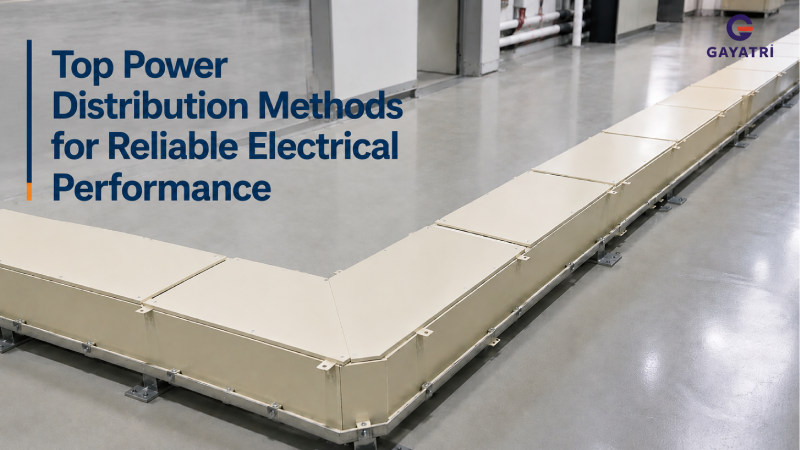
For very high current applications — think large industrial plants or facilities with heavy machinery — bus ducts are increasingly replacing traditional cable-and-tray runs. A bus duct carries power through a rigid, enclosed conductor system rather than flexible cables, which reduces voltage drop over long runs, saves installation space, and simplifies future load additions through tap-off points along the duct.
This method pairs naturally with centralized distribution boards that act as the source and protection point for the entire bus duct run, making the quality of the originating panel critical to the performance of the whole system.
What to Look for in a Power Distribution Board
Regardless of which distribution method a project uses, the distribution board itself is the heart of the system. A handful of technical factors determine whether a board will perform reliably over its service life:
- Current handling capacity — boards should be rated with enough headroom for both current load and future expansion, with high-capacity boards now available up to 6300A for demanding industrial applications.
- System and insulation voltage rating — a board rated for 440 Volt AC system voltage with a 690 Volt AC insulation rating provides a safety margin that protects against transient surges.
- Ambient temperature tolerance — boards engineered to perform reliably at ambient temperatures up to 50°C are essential for Indian industrial environments, especially in regions with intense summer heat.
- Degree of protection (IP rating) an IP54 rating protects internal components from dust and splashing water, which matters in most industrial and semi-outdoor installations.
- Build quality and compliance — panels built to recognized standards, with quality busbars, breakers, and enclosures, reduce long-term maintenance and failure rates.
These are exactly the specifications engineered into the distribution boards manufactured by Gayatri Private Limited, making them suitable for demanding industrial, commercial, and infrastructure environments across the country.
Why Choose us
Gayatri Private Limited brings over three decades of hands-on experience in high and low voltage infrastructure, having delivered projects for major government and private organizations including ISRO, IOCL, NHPC, Indian Railways, and various municipal corporations. This depth of project experience means every distribution board is designed with real-world operating conditions in mind, not just catalog specifications. As an authorized Siemens partner, the company combines global component quality with local manufacturing expertise, resulting in power distribution boards rated up to 6300A, built for 440 Volt AC systems with a 690 Volt AC insulation rating, engineered to withstand ambient temperatures up to 50°C, and protected to an IP54 standard. Whether the requirement is a straightforward radial setup for a commercial building or a complex networked distribution system for a continuous-process plant, Gayatri Private Limited has the engineering depth, manufacturing capability, and project track record to deliver a solution that performs reliably for years. This combination of experience, certified partnerships, and rigorous build quality is why so many procurement teams searching for the Best Power Distribution Board Manufacturers in India consistently choose to work with Gayatri Private Limited.
Conclusion
Choosing the right power distribution method, and the right manufacturer behind it, directly determines how safely and efficiently a facility operates over its lifetime. From simple radial layouts to complex networked systems, every method depends on distribution boards that are built to handle real-world current loads, voltage stress, and environmental exposure without compromise. With decades of project experience and Siemens-partnered engineering standards, Gayatri Private Limited continues to be a name procurement and engineering teams trust for dependable, long-lasting electrical infrastructure across India’s industrial and commercial sectors.
Need a reliable power distribution board for your next project? Talk to Gayatri Private Limited today — call +91 9375065185 or email marketing@gayatrigroup.org
Frequently Asked Questions
What are the top power distribution board manufacturers in India?
The top power distribution board manufacturers in India include Gayatri Private Limited, which offers high-quality, compliant solutions tailored to various industrial and commercial needs. These manufacturers prioritize durability, technical support, and customization based on specific applications.
How does a radial distribution system work?
A radial distribution system operates by delivering power in one direction from a single source through a distribution board to various loads. While it’s simple and cost-effective, the trade-off is that if the primary source fails, all downstream power is lost until repairs are made.
What factors should I consider when selecting a power distribution board?
When selecting a power distribution board, consider factors such as current handling capacity, system voltage ratings, ambient temperature tolerance, and degree of protection (IP rating). Ensuring that the board meets recognized standards and is built for specific operating conditions is crucial for long-term reliability.
Why is the choice of power distribution board manufacturers important in India?
Choosing reputable power distribution board manufacturers in India is essential because they ensure compliance with electrical standards and provide products designed for real-world operating conditions. Companies like Gayatri Private Limited combine quality components with local manufacturing expertise to deliver solutions that enhance operational efficiency and safety.
What benefits do interconnected distribution systems offer?
Interconnected distribution systems provide the highest reliability by allowing multiple power sources and paths for distributing electricity. This setup ensures that if one source fails, the system can reroute power through alternative connections, which is critical for facilities where downtime is not an option.