


Key Takeaways
- VFD panels significantly reduce energy waste by adjusting motor speed to match process demand.
- Choosing the right VFD Panels Manufacturers in India can optimize your motor control solutions.
- Lowering motor speed can lead to substantial energy savings in pumps and fans.
- VFD control enhances process flexibility, allowing motors to operate efficiently under varying conditions.
- Energy savings from VFD usage depend on the specific load profile and operational conditions.
Gayatri Group, is a leading manufacturer of VFD Panels for industrial motor-control and power-distribution applications.
Industrial motors often operate under changing process demand, but a fixed-speed motor does not automatically reduce its output when less flow, pressure, or machine speed is required. This is when VFD control proves particularly useful. As one of the VFD Panels Manufacturers in India, we design solutions that allow motor speed to follow actual operating requirements rather than forcing the motor to run continuously at one speed.
Why Fixed-Speed Motor Operation Can Waste Energy
A conventional motor connected directly to the supply generally operates close to its rated speed whenever it is switched on.However, equipment like centrifugal pumps and fans may need to operate at full capacity only under specific operating conditions.
Flow may instead be restricted mechanically through valves, dampers, or similar control methods while the motor continues running at high speed. A VFD takes a different approach: it adjusts the electrical frequency supplied to the motor so motor speed can be matched more closely with process demand.
That difference is important because reducing motor speed can significantly reduce power demand in suitable variable-torque applications such as centrifugal pumps and fans. According to the U.S. Department of Energy, VFD-based speed regulation in these applications operates in accordance with the affinity laws when the required conditions are met.
How a VFD Panel Controls Motor Energy Consumption
A VFD panel does not simply switch a motor ON and OFF. The drive controls motor speed by varying the supplied voltage and frequency to match the required operating conditions.
In real-world industrial settings, the control process typically follows this sequence:
- The process creates a demand for flow, pressure, airflow, or machine speed.
- A control signal communicates the required operating level to the drive.
- The VFD adjusts its output frequency.
- Motor speed changes according to the command.
- The motor regulates its energy usage according to operational requirements instead of running at full speed all the time..
For B2B buyers evaluating VFD Panels Manufacturers in India, this process-based approach is more relevant than simply comparing panel enclosures. The system’s performance depends on several factors, including the drive’s specifications, motor properties, selected control strategy, protective measures, intended application, and operating conditions.
Why Pumps Can Benefit Strongly from VFD Control
Centrifugal pumping systems are one of the most important applications for variable-speed operation. When demand falls, running the pump at full speed and restricting flow through a throttling valve can waste energy.
VFD control allows the pump to operate at variable speeds, automatically adjusting its output to match the required flow rate.Under ideal affinity-law conditions, power changes approximately with the cube of speed for variable-torque centrifugal loads. The Department of Energy gives an example in which operating at 75% speed can reduce motor demand substantially compared with full-load operation.
The key energy-saving opportunity is not simply installing a VFD; it is allowing motor speed to fall when the process genuinely requires less output.
Why Fans Respond Well to Speed Control
The industrial fans such as ventilation fans, cooling fans, exhaust fans, blowers and air handlers usually have variable flow requirements.
Historically, the flow of these systems has been regulated through dampers but the speed of the motor has been more or less constant. However, a VFD will allow reduction in speed rather than regulating flow through dampers. According to affinity laws, for centrifugal fans, there is a rapid decrease in the requirement of power as speed is decreased.
According to US Department of Energy, for proper applications of pumps and fans, a 10% reduction in speed results in 30% power reduction based on affinity laws.
VFD Panels in Industrial Machines
Energy savings in industrial machines depend much more heavily on the type of load than they do in centrifugal pumps and fans. Conveyors, mixers, machine tools, process lines and other motor-driven equipment can have different torque requirements.
VFDs may still be useful because they allow controlled speed adjustment, acceleration and process matching, but energy savings should not be assumed to follow the pump-and-fan cube relationship for every machine.
This distinction matters when selecting among VFD Panels Manufacturers in India. A responsible panel solution should be based on the motor and driven equipment rather than applying one energy-saving claim to every industrial application.
VFD Control vs Fixed-Speed Operation
The difference becomes clearer when both approaches are compared on practical operating criteria.
Operating Factor | Fixed-Speed Motor | VFD-Controlled Motor |
Motor speed | Generally constant | Adjustable |
Process control | Often mechanical or ON/OFF | Speed-based control |
Pump/fan partial load | Motor may remain at high speed | Speed can follow demand |
Starting | Direct or starter dependent | Controlled acceleration |
Energy opportunity | Limited when speed remains fixed | Strong in suitable variable-load applications |
Process flexibility | Lower | Higher |
A VFD is therefore most valuable when process demand changes frequently and the motor does not need to operate continuously at full speed.
What Determines the Actual Energy Saving?
Simply installing a VFD does not automatically result in a specific percentage of electricity savings. Savings depend on how the equipment operates before and after speed control is introduced.
Plant teams should review:
- Motor rating and efficiency
- Pump, fan, or machine load profile
- Average operating speed
- Hours of operation
- Existing valve or damper control
- Required pressure, flow, or torque
- Motor compatibility with variable-frequency operation
A system that spends significant operating time below full demand generally presents a different opportunity from one that must run continuously near rated output.
Matching the VFD Panel to the Application
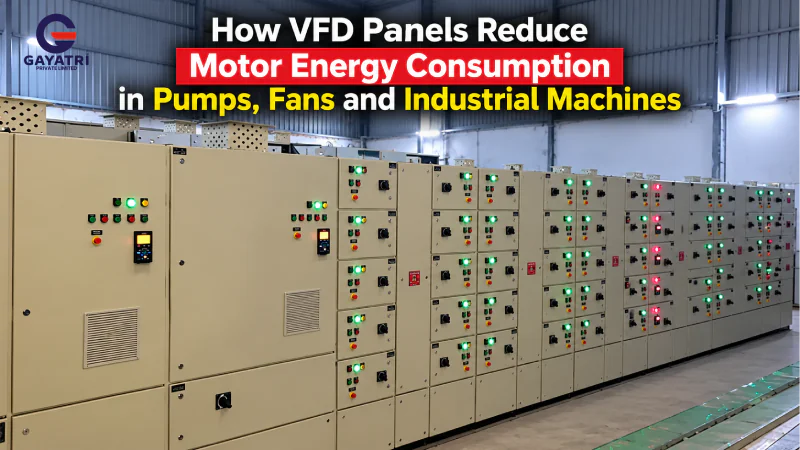
The Gayatri Group Automation Panels include VFD panels suitable for power distribution and motor control application. The existing specification of the panel involves 440V AC system voltage, current capacity up to 6300A, 690V AC rated insulation voltage and IP54 protection.
Such specification makes assessment of the application vital. This requires consideration of motor rating, starting, control system, environmental factors, cabling, and the process involved.
Why Choose Us
At Gayatri Group, we take into consideration the needs of VFD panels from the point of view of Industrial Power Distribution and Control of Motors instead of considering VFD panels as a standalone product. We have an Automation Panel which has options for configuring VFD and Soft Starter Panel. Being one of the best VFD Panels Manufacturers in India, we make sure to understand the motor, load connected to it, surrounding environment, and control requirements so that the panel is suitable for its application.
Conclusion
The use of VFD panels in motor operation can help in reducing motor energy usage by enabling motor speed adjustment according to the process demand. The chances are much greater in applications involving appropriate centrifugal pumps and fans, where there is an extensive reduction in power usage when the speed reduces. Industries can as well gain from variable motor speeds based on the behavior of the machines and their torque and speed nature. At the Gayatri Group, we feel that selection of VFDs should start with the application, motor, and load profile. Cooperation with VFD Panels Manufacturers in India will make industries come up with appropriate motor control solutions.
If your plant operates pumps, fans, conveyors or other motor-driven equipment and you are planning a VFD-based motor-control solution, Gayatri Group can help you evaluate the panel requirements for your application.
Call +91 9375065185 or email marketing@gayatrigroup.org today to discuss your VFD Panel requirement and request a quotation.
Frequently Asked Questions
What are VFD panels and how do they work?
VFD panels, or Variable Frequency Drive panels, control the speed and torque of electric motors by varying the voltage and frequency supplied to them. They allow motors to adjust their performance based on real-time process demands, which improves energy efficiency and reduces unnecessary energy consumption.
What benefits do VFD panels offer for pumps and fans?
VFD panels significantly enhance energy efficiency for pumps and fans by allowing them to operate at variable speeds. By adjusting motor speed to match actual flow or pressure requirements, they can achieve substantial power savings compared to fixed-speed operation.
How do VFD panels reduce energy consumption in industrial machines?
VFD panels help reduce energy consumption in industrial machines by allowing for controlled speed adjustments that match the process requirements. This capability is particularly useful for applications with varying load profiles, which minimizes energy waste often seen in fixed-speed operations.
What should I consider when choosing VFD Panels Manufacturers in India?
When selecting VFD Panels Manufacturers in India, consider factors like the specific motor and load requirements, the intended application, and the panel’s specifications such as voltage and current capacity. Collaborating with manufacturers that prioritize customized solutions will ensure optimal efficiency and performance.
Can VFD panels be used in all types of industrial applications?
While VFD panels are highly effective in many applications, including pumps and fans, their energy-saving benefits vary depending on the type of load. It’s essential to match the VFD panel to the specific application and load characteristics to maximize efficiency.