

Key Takeaways
- A DG Synchronizing Panel efficiently synchronizes multiple diesel generators for reliable power supply in critical facilities.
- Key benefits include uninterrupted power, fuel efficiency, and extended generator life for industrial applications.
- Gayatri Private Limited is a trusted DG Synchronizing Panel Manufacturer in India, offering high-quality solutions for diverse sectors.
- The panel supports both automatic and manual modes for flexibility in operation and reduced operator dependency.
- Comprehensive protection relays safeguard generators against abnormal conditions to ensure operational safety.
Modern industries, commercial facilities, hospitals, manufacturing plants, data centers, and infrastructure projects require uninterrupted power for smooth operations. Power failures can result in production losses, equipment damage, and operational disruptions. To address these challenges, organizations rely on multiple diesel generator sets that work together to provide a stable and reliable power supply. This is where a DG Synchronizing Panel plays a critical role.
A DG Synchronizing Panel is an advanced electrical control panel designed to synchronize multiple diesel generators and manage their operation efficiently. It enables generator sets to operate in parallel while sharing loads proportionally, improving fuel efficiency, reliability, and operational flexibility. Businesses looking for dependable power management solutions often prefer a trusted DG Synchronizing Panel Manufacturer in India to obtain high-quality systems that meet industrial requirements.
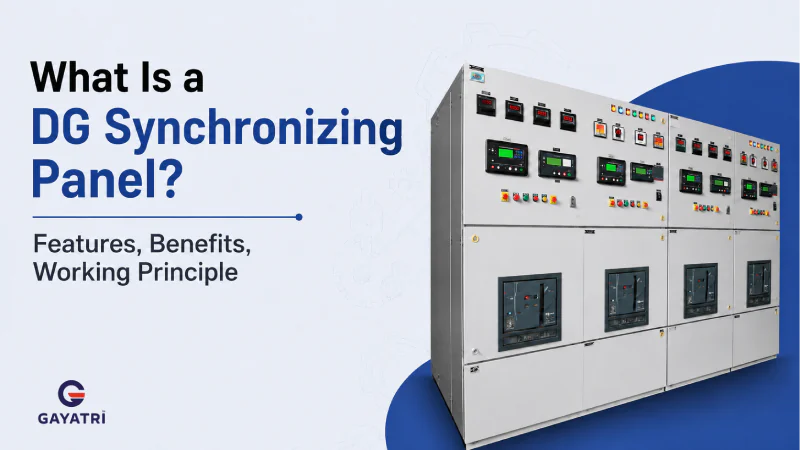
What Is a DG Synchronizing Panel?
A DG Synchronizing Panel — also called a DG sync panel or generator paralleling panel — is a low-tension switchgear assembly that manages the process of synchronizing two or more diesel generators (DGs) to each other and/or to the utility grid supply, so they can operate in parallel and share the connected electrical load.
The word “synchronizing” here has a precise technical meaning. Before any two AC power sources can be connected in parallel, they must be in sync — matching in voltage magnitude, frequency, phase angle, and phase sequence. Connect two out-of-sync generators without proper synchronization, and the resulting circulating currents can be severe enough to damage generator windings, trip breakers, or cause voltage and frequency disturbances that harm connected loads. The DG synchronizing panel manages this entire process, either automatically through a synchronizer controller or with manual assistance and instrumentation support.
Beyond synchronization, the panel also handles load sharing — distributing the total connected load proportionally across all running generators based on their rated capacity — and load management, including automatic addition or removal of generators as the facility’s load rises or falls.
How Does a DG Synchronizing Panel Work?
The working principle of a DG Synchronizing Panel follows a clear sequence, though the sophistication of that sequence varies depending on whether the panel is manually operated, semi-automatic, or fully automatic.
Step 1 — Generator Start and Run-Up: When a mains failure is detected (or when a planned paralleling operation is initiated), the generators are started and allowed to run up to their rated speed. During this phase, the voltage and frequency of each incoming generator are monitored continuously by the synchronizer module inside the panel.
Step 2 — Synchronization Check: The synchronizer compares the incoming generator’s voltage, frequency, and phase angle against the busbar (which carries the reference — either the running bus voltage or the grid voltage). It monitors four key parameters: voltage difference, frequency difference, phase angle difference, and phase sequence. The synchronizer makes fine adjustments — signaling the generator’s AVR (Automatic Voltage Regulator) for voltage matching and the governor for frequency/speed matching — until all four parameters are within the acceptable synchronization window.
Step 3 — Breaker Closing: Once synchronization is achieved, the synchronizer sends a close command to the generator’s ACB (Air Circuit Breaker) at precisely the right moment — typically when the phase angle slips between the incoming source and the busbar is at or approaching zero. This is called “slip synchronization,” and getting it right is what separates a smooth parallel connection from a damaging out-of-phase closure.
Step 4 — Load Sharing: After the breaker closes and the generator is connected to the bus, the load-sharing module takes over. It monitors the kW and kVAr output of each running generator and adjusts governor and AVR signals to distribute the load proportionally across all machines. This prevents one generator from being overloaded while another runs light.
Step 5 — Load Management: In facilities where load varies significantly — a hospital, for example, where night-time loads are much lower than daytime — the load management function of the DG Synchronizing Panel automatically starts additional generators as load increases and shuts down excess generators as load drops, maintaining fuel efficiency without operator intervention.
Step 6 — Grid Return / De-Synchronization: When utility supply returns, the panel re-synchronizes the generator bus to the grid, transfers the load back smoothly, and then shuts down the generators in sequence.
Key Features of Gayatri Private Limited’s DG Synchronizing Panel
Gayatri Private Limited engineers its DG Synchronizing Panels with a feature set that reflects real operational requirements — not just minimum specification compliance.
High Current Capacity — Up to 4000A: With a maximum rated current of 4000A, these panels are built for large-scale facilities with multiple high-capacity generators. Whether you are running two 1000 kVA DGs in a data center or four 2000 kVA machines in a large industrial plant, the panel’s busbar and switching architecture is sized for the load.
System Voltage — 440V AC, Insulation Voltage — 690V AC: These are the standard LT distribution parameters for Indian industrial and commercial installations. The insulation voltage rating of 690V AC provides a meaningful safety margin above the system voltage, protecting the panel against voltage transients and harmonic distortions encountered in generator-fed systems.
IP54 Degree of Protection: The panel enclosure carries an IP54 rating — protected against dust ingress and water splashing from any direction. This makes it suitable for electrical rooms in industrial plants, basements of commercial buildings, and semi-protected outdoor generator yards where dust and occasional moisture exposure are realities of the operating environment.
50°C Ambient Temperature Rating: Indian generator rooms are often hot. Between the heat generated by the DG sets themselves and the high ambient temperatures of Indian summers, electrical panel rooms near generator areas regularly see temperatures well above 40°C. Every component in Gayatri Private Limited’s panel — ACBs, busbars, control relays, synchronizer modules — is selected for reliable operation at up to 50°C ambient.
Auto/Manual Synchronizing Modes: The panel supports both automatic synchronizing (where the synchronizer controller handles the entire process without operator input) and manual synchronizing (where the operator uses synchroscope instrumentation and phase-matching indicators to close the breaker manually). Having both modes available is critical for operational flexibility and for manual backup in case of controller issues.
Comprehensive Protection Relays: The panel integrates protection relays for overcurrent, earth fault, reverse power (to prevent motoring of a generator), loss of excitation, under/overvoltage, and under/over frequency. These protections work together to safeguard the generators and the connected loads from a wide range of abnormal operating conditions.
Load Sharing and Load Management Controllers: Dedicated load-sharing controllers receive real-time kW and kVAr signals from each generator’s current and voltage transformers and continuously adjust governor and AVR signals to maintain proportional load sharing. The load management module adds or removes generators from service based on pre-set load thresholds.
Mimic Diagram and Annunciator: A clear mimic diagram on the panel front door gives operators an instant visual picture of the power system status — which generators are running, which breakers are closed, and what the bus configuration looks like. An annunciator with audiovisual alarms alerts operators to abnormal conditions before they develop into failures.
Benefits of Using a DG Synchronizing Panel
Installing a DG Synchronizing Panel delivers concrete operational and financial benefits that go well beyond simply having backup power available.
Uninterrupted Power Supply to Critical Loads: The most direct benefit. By seamlessly coordinating generator start-up, synchronization, and load transfer, the panel minimizes power interruption to critical loads during mains failure events. For hospitals, data centers, and process plants, this means the difference between safe operation and potentially catastrophic interruption.
Fuel Efficiency Through Load Management: Running four generators at 25% load each is significantly less fuel-efficient than running two at 50% load. The load management function of the DG Synchronizing Panel continuously optimizes the number of running generators to match the actual load, delivering meaningful fuel savings over the operational life of the installation.
Extended Generator Life: Generators that are persistently underloaded suffer from wet stacking and other mechanical issues. Generators that are overloaded run hot and age prematurely. Proper load sharing and load management through the sync panel keeps each generator operating in its optimal load range, extending its service life.
Scalability: A synchronizing panel architecture allows additional generators to be added to the system as the facility’s power requirements grow — without replacing the entire power system. This scalability is particularly valuable for facilities with phased expansion plans.
Reduced Operator Dependency: Fully automatic synchronizing and load management dramatically reduce the level of operator skill and attention required to manage a multi-generator system. This reduces the risk of human error during critical switching operations and allows facilities to operate safely even with less experienced electrical staff on shift.
Applications Across Industries
Any facility that runs several generators or requires smooth generator-to-grid transfer must have a DG synchronizing panel. Gayatri Private Limited has supplied these panels across a wide range of sectors:
Hospitals and Healthcare: Critical care environments where even a few seconds of power interruption can have life-threatening consequences use fully automatic DG synchronizing panels as the backbone of their emergency power systems.
Data Centers and IT Facilities: Tier III and Tier IV data centers with redundant power architecture use synchronizing panels to manage parallel UPS-backed generator systems, maintaining N+1 or 2N power redundancy.
Large Industrial Plants: Steel plants, cement factories, petrochemical refineries, and pharmaceutical manufacturing facilities all operate multiple large DG sets for process continuity during grid outages. Gayatri Private Limited’s experience with IOCL and similar industrial clients directly informs the design of its panels for these demanding environments.
Hotels and Commercial Complexes: Large hospitality and commercial properties use DG sync panels to manage backup power for lifts, HVAC, kitchen equipment, and guest services seamlessly during outages.
Government and Infrastructure Projects: ISRO facilities, NHPC hydro stations, railway installations, and municipal infrastructure projects all require reliable backup generation systems with proper synchronizing panels.
Why Choose us
Gayatri Private Limited has spent over 40 years building electrical panels for India’s most demanding projects, and the DG synchronizing panel range reflects every lesson learned from that experience. The company has delivered solutions to organizations like ISRO, NHPC, IOCL, Indian Railways, and Municipal Corporations — clients who set extremely high bars for reliability, documentation, and performance under pressure. As a leading DG Synchronizing Panel Manufacturer in India, Gayatri Private Limited brings not just manufacturing capability but genuine application engineering expertise to every project. The panels are rated for 50°C ambient, built to IP54 protection standards, and capable of handling currents up to 4000A — specifications chosen because they reflect the actual operating conditions of Indian industrial and commercial installations, not idealized laboratory environments. With a track record of over 5,000 completed projects and 2,500 satisfied clients across government and private sectors, Gayatri Private Limited is the partner you can count on for a synchronizing panel that works exactly as it should, on the day it is needed most.
Conclusion
A DG Synchronizing Panel is not just a switchgear item — it is the intelligence layer of your backup power system. It decides when generators come online, how they share the load, how efficiently they run, and how smoothly they hand power back to the grid when supply returns. Getting this panel right — in terms of specifications, features, and manufacturing quality — has a direct impact on your facility’s power reliability, fuel costs, equipment life, and operational safety. Gayatri Private Limited brings four decades of field-proven engineering expertise to every panel it manufactures, making it the right choice for any facility that takes power reliability seriously.
Get the right DG Synchronizing Panel for your facility from Gayatri Private Limited — engineered for India’s toughest power reliability demands, backed by 40 years of manufacturing excellence.
Call us: +91 9375065185 Email us: marketing@gayatrigroup.org
Frequently Asked Questions
What is a DG Synchronizing Panel?
A DG Synchronizing Panel, also known as a generator paralleling panel, is an electrical control panel that synchronizes multiple diesel generators to operate in parallel. It ensures that the generators match in voltage, frequency, phase angle, and phase sequence before they are connected to share the electrical load.
What are the key features of DG Synchronizing Panels?
Key features include high current capacity up to 4000A, IP54 protection against dust and moisture, and support for both auto and manual synchronization modes. They also include load-sharing controllers and comprehensive protection relays to ensure reliable operation.
How does a DG Synchronizing Panel improve fuel efficiency?
By optimizing load management, a DG Synchronizing Panel ensures that generators run at their ideal load levels. This reduces wasteful fuel consumption compared to running multiple generators at low loads, thus enhancing overall fuel efficiency.
Why choose a DG Synchronizing Panel Manufacturer in India?
Choosing a DG Synchronizing Panel Manufacturer in India, like Gayatri Private Limited, ensures that the systems are designed for local conditions and specifications. With decades of experience and a focus on reliability, quality, and compliance, these manufacturers meet the specific needs of Indian industries.
What are the applications of DG Synchronizing Panels?
DG Synchronizing Panels are used in a variety of applications including hospitals for critical power needs, data centers for power redundancy, and industrial plants for continuous operation during outages. They are essential in any facility that requires reliable backup power and seamless generator management.